



TL:DR
- Digital sovereignty covers enterprise control over data, networks, operations & AI — & the right approach varies by organization, industry & jurisdiction.
- Equinix colocation, private interconnection & Fabric Geo Zones help customers enforce geo-bound data routing & residency requirements across multiple regions.
- 3 global use cases show how Equinix & GSI partners assemble sovereign digital infrastructure architectures that balance local compliance with global business goals.
Digital sovereignty is top of mind for many business leaders, but exactly what that entails will look different for each leader and each organization.
For instance, a sovereign solution in Europe will look much different from one in the U.S. Different industry verticals will also have different sovereignty requirements. Thus, each organization will have its own unique understanding of sovereignty based on where it operates, who it works with, and what it’s trying to accomplish.
What is digital sovereignty?
There’s no universally accepted definition of digital sovereignty because it’s not one specific requirement that all organizations need to meet. It’s more of an umbrella concept covering the control enterprises need across data, networks, operations and AI to manage dependencies and preserve their freedom to act where it matters.
It may be equally helpful to establish what digital sovereignty is not:
- Digital sovereignty is not a product you buy from a vendor. It’s something you design for. It requires the right partnerships, policies and planning, so that when the time comes to pick the right technology, you’ll be able to do so easily.
- Digital sovereignty is not compliance. Governments create regulations to protect their citizens and economic interests, and these regulations might include sovereignty requirements. But true sovereignty isn’t just the bare minimum required by law. It’s about mitigating risk and ensuring control throughout the organization.
- Digital sovereignty is not the end goal: Enterprises must balance sovereignty requirements against business priorities: things like performance, resilience, scalability and speed. Pursuing sovereignty for its own sake isn’t helpful, especially if it interferes with these core business goals.
In practice, digital sovereignty is rarely a solo activity. There are simply too many different regulations and requirements across different jurisdictions for an enterprise to navigate alone. They need help translating country-level compliance into clear, non-negotiable architectural requirements. They need help balancing local regulations against global expansion goals. And they need flexibility to work with many different cloud, network, AI and sovereignty service providers as requirements change. Because regulations, technologies and business priorities are always changing, the architecture must also adapt to future sovereignty requirements.
This is where Equinix comes in. We offer a global portfolio of vendor-neutral colocation data centers, low-latency interconnection solutions, and key ecosystem partners like cloud and network providers. Our global systems integrator (GSI) partners can assemble these building blocks into scalable architectures that support sovereignty requirements on behalf of our joint customers.
Below, we’ll look at how Equinix and our partners enabled digital sovereignty for three different customers from across the globe. Each example addresses a particular sovereignty requirement rather than every dimension of digital sovereignty. Together, they show how organizations combine controls according to their risks, workloads and jurisdictions.
Use Case #1: Australian DRaaS provider supports regulated customers
Australian businesses are subject to three regulations that support digital sovereignty within their own country: the Privacy Act of 1988[1], the Australian Privacy Principles Chapter 8 (APP 8)[2] and the Security of Critical Infrastructure (SOCI) Act of 2018.[3] Many of these businesses are also working to expand into other parts of the Asia-Pacific region, potentially opening themselves to new regulations in new countries. At the same time, they’ll likely need to work with global providers to support their expansion goals.
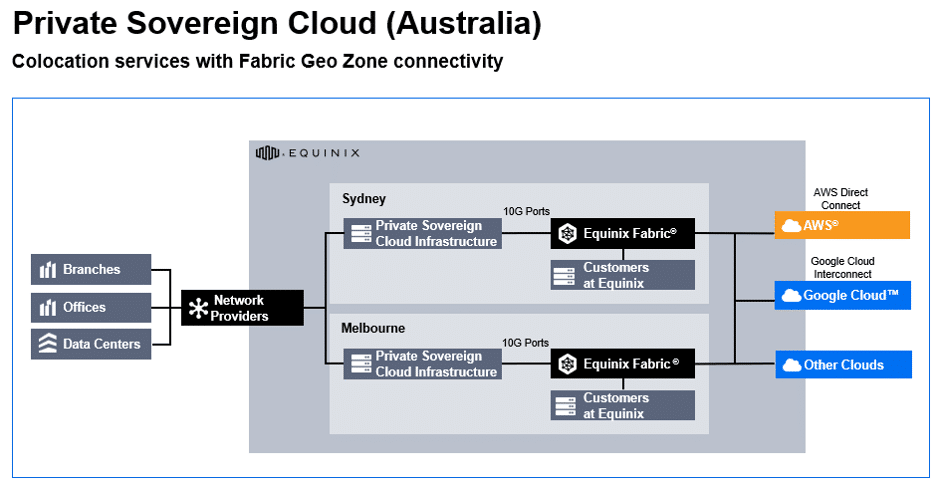
This was the situation facing one Equinix customer, an Australian Disaster Recovery as a Service (DRaaS) provider. They work with customers in heavily regulated industries like financial services, which means they frequently handle sensitive datasets that must remain inside national borders. They also needed low-latency connectivity to cloud and network providers to help ensure global reach for their solutions.
The customer now stores their regulated data inside Equinix colocation data centers spread across six Australian metros. Equinix simply provides power and space; any equipment that customers deploy at Equinix remains theirs to manage as they see fit.
Because customers own and operate their equipment, Equinix does not possess or control their workloads and data as a cloud provider would. This creates a materially different position when assessing exposure under the U.S. CLOUD Act.
Real sovereignty requires control over data in motion, not just data at rest. Equinix delivers here as well. The customer uses Equinix Fabric® virtual private interconnection to move data via direct, low-latency paths. Data permitted to leave Australia can move over direct private connections rather than the public internet.
The customer also uses Equinix Fabric Geo Zones to define geographic boundaries for Fabric connectivity, helping keep selected data flows within approved Australian locations. If no geographically compliant path exists, then the data drops. This strengthens control over data in motion as part of the customer’s wider sovereignty architecture.
Use Case #2: U.K. government agency adopts cloud at scale while protecting sensitive data
Think about the last time you interacted with a government office for some kind of citizen service, like renewing a driver’s license or a passport. Did you ever stop to think about why the process works the way it does, or what happened to your data after you left? Would better technology have made the experience quicker and easier?
Chances are there’s some interesting work happening behind the scenes to meet this goal, and to better protect the data you entrusted to the agency. Many agencies have been tasked with improving the user experience for citizens, and IT modernization is one way they’re working to do that.
They’re pivoting away from inflexible long-term contracts, in favor of a cloud-first approach that enables greater agility and responsiveness. However, they also need to ensure that scaling up cloud adoption does not put their sovereignty requirements at risk.
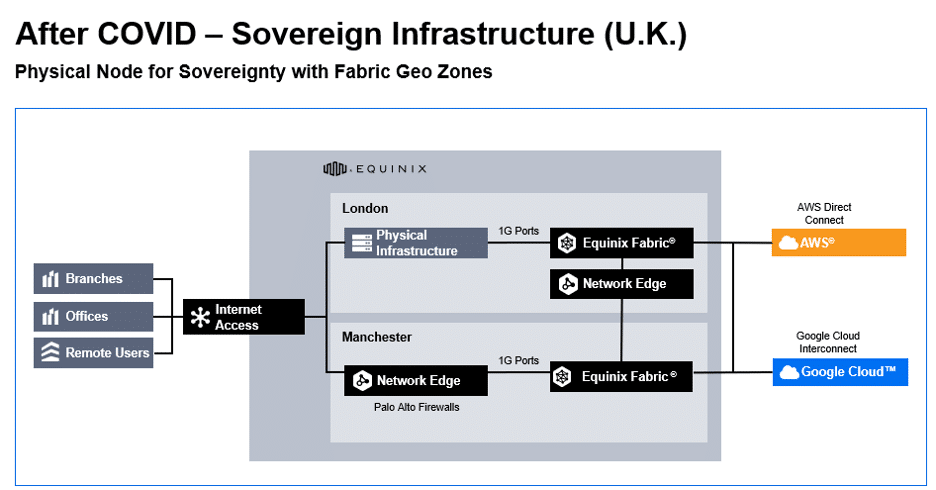
One Equinix public-sector customer in the U.K. ran into a challenge as they pursued IT modernization: In the aftermath of the COVID pandemic, they were struggling to scale their VPN-based cloud access, which limited performance and resilience.
The U.K. Government “does not have an overarching policy on digital sovereignty.”[4] Instead of a dedicated statute, control over digital infrastructure and data is managed through several key legal and regulatory mechanisms.
To bypass networking bottlenecks while also navigating the regulatory landscape in the U.K., the agency deployed redundant Palo Alto Networks virtual firewall devices from the Equinix Network Edge portfolio. These devices came pre-connected to Equinix Fabric and Equinix Internet Access, making it quick and easy to connect their private offices to their multicloud environment. The agency can now set new cloud connections in days, not months. They also decreased the average latency to reach the cloud from 25 milliseconds to 8 milliseconds.
The agency later chose to expand their Equinix presence with a physical network access point in London, in addition to their virtual solutions. They were able to connect this London PoP to Manchester using Fabric Geo Zones for geo-bound routing within British territory.
Use Case #3: Brazilian financial market enables low-latency trading within regulatory boundaries
It’s often said that money never sleeps, and capital markets are the proof. They’re made up of different firms from across the world, all of which are constantly chasing new trading opportunities. They need extremely low latency and deterministic performance to act on these opportunities before they disappear. These markets occupy an important place in the economies of their respective nations, so they typically also face strict data residency and compliance requirements.
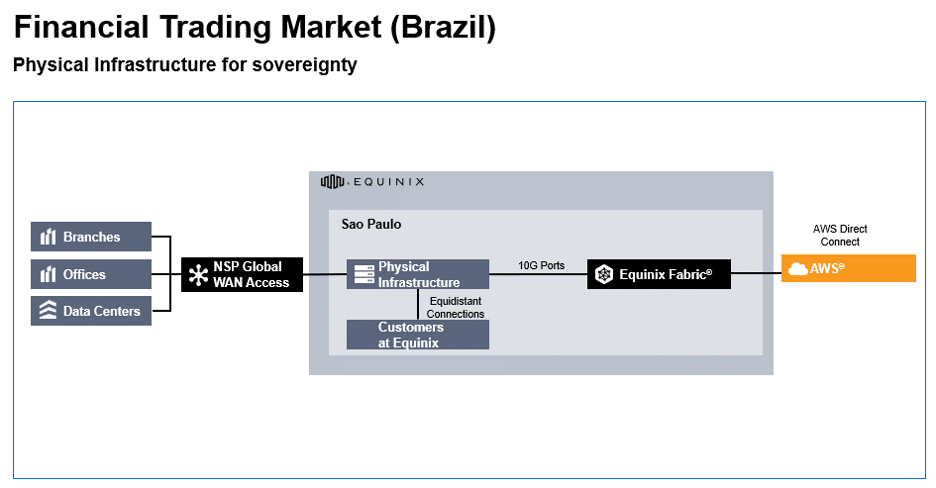
This was the case for one Equinix customer, a Brazilian stock exchange. The exchange is subject to regulations like the LGPD, Brazil’s data protection law, as well as requirements set by the Central Bank of Brazil. Also, Brazil is actively building its digital sovereignty through federal data center policies, platform accountability rules, and strict privacy regulations managed by the National Data Protection Authority (ANPD).[5]
This customer needed to support global firms looking to trade in Brazil, while also keeping up with the changing regulatory landscape and ensuring that core market data and systems remain under Brazilian legal authority.
The customer worked with an Equinix partner GSI to create a flexible network architecture that supported their regulatory requirements. This architecture includes Fabric Geo Zones to enable geo-bound network routing within Brazil. As a result, global trading firms are now able to participate in Brazilian markets without having to relocate their sensitive data.
GSIs help put sovereignty into action for Equinix customers
The examples above demonstrate how Equinix and our partner ecosystem help customers balance business goals against sovereignty requirements. They all face unique requirements within their own jurisdictions, and there’s no off-the-shelf sovereignty solution for them to buy. Equinix provides customer-controlled infrastructure, connectivity and ecosystem access, while our GSI partners bring the expertise to assemble these building blocks into scalable, region-aware architectures.
These architectures provide a repeatable starting point that can be adapted to the requirements of each market.
The same approach is increasingly relevant to sovereign AI. Equinix Distributed AI™ Hub helps connect private infrastructure and data with a choice of AI models, tools and service providers, while GSIs design the broader architecture, governance and operating model.
Learn more about the Equinix approach to digital sovereignty: Read the brief “Sovereign control with global reach.”
Also, we invite GSIs to learn how we can work together to drive meaningful AI results for customers: Read the brief “Accelerate time-to-value with globally distributed AI.”
[1] The Privacy Act, Office of the Australian Information Commissioner, Australian Government.
[2] Chapter 8: APP 8 Cross-border disclosure of personal information, Office of the Australian Information Commissioner, Australian Government.
[3] Security of Critical Infrastructure Act 2018 (SOCI), Department of Home Affairs, Australian Government.
[4] Digital sovereignty, House of Commons Library, U.K. Parliament, March 6, 2026.
[5] ANPD, Ministry of Justice and Public Security, Government of Brazil.


 Subscribe to the Equinix Blog