



TL:DR
- Financial institutions relying on a single cloud provider for AI capacity could experience concentration risk, limiting flexibility, negotiating leverage and operational resilience.
- A hybrid AI infrastructure strategy places workloads across public cloud, neocloud, colocation and private environments based on performance, sovereignty and cost needs.
- Neutral digital infrastructure with access to diverse cloud and neocloud providers helps financial firms preserve control and adapt as AI capacity requirements evolve.
Many financial institutions use AI to enable mission-critical applications like fraud detection, risk scoring, and real-time decision-making. These AI-driven applications help them move faster and drive new business value. But they also introduce new dependencies. If they can’t get the hardware, power, models and datasets needed to execute their AI strategy, then they won’t be able to ensure operational resilience.
AI is driving higher demand across every rung of the IT stack:
- Demand for data center power will increase 165% between 2023 and 2030, according to Goldman Sachs Research.[1]
- During 2026, AI-related demand is expected to consume about 60% of the output of Taiwan Semiconductor’s 3-nanometer (N3) semiconductor nodes.[2]
Many financial institutions turn to cloud hyperscalers to help break these AI supply-chain bottlenecks. Their access to advanced chips, memory and managed AI platforms gives financial firms capabilities they may struggle to source independently. For experimentation and rapid deployment, public cloud can be the fastest route to value. But using cloud to solve capacity problems can also create concentration risk, where the organization becomes dependent on one provider, one model ecosystem or one operating environment.
The fastest route to capacity could become a path to lock-in
In a recent blog post, our Equinix colleague highlighted concentration risk at the network level. The same problem is also arising with AI.
When enterprises originally started their cloud-first mandate, they tended to work with a single cloud provider. This proved to slow innovation, so organizations changed course, rearchitecting for multicloud designs. Now, as AI value scales, many of them are repeating the same mistakes. They’re concentrating their AI Infrastructure in a single cloud environment to simplify procurement and operations and accelerate deployment. But over time, applications can become tightly coupled to proprietary models, data services, orchestration tools and networking patterns. Switching providers then becomes a complex, time-consuming redesign project.
For financial institutions, the consequences extend beyond vendor lock-in. Excessive dependence on one provider can reduce negotiating leverage, constrain access to new models, complicate third-party risk management, and limit the ability to meet changing sovereignty, data residency and governance requirements. The organization may still own its data and applications, yet lose practical control over where workloads run and how readily they can move.
The objective is not to avoid cloud. It’s to preserve control while using cloud selectively. That means keeping multiple viable paths to infrastructure, models and data services, and designing for change before a provider transition becomes urgent.
Neoclouds enable AI infrastructure flexibility
Neoclouds have become a valuable alternative to cloud hyperscalers for AI infrastructure. The neocloud market is forecasted to generate $250 billion in revenue from GPU as a Service by 2030.[3] Major names like CoreWeave and Nebius are already multibillion-dollar companies.
Neocloud services can sometimes be significantly more cost-efficient than hyperscale services, but the value of neoclouds extends beyond simple dollars and cents. They help financial firms overcome concentration risk by giving them additional options to access the AI compute they need.
For European financial firms, working with neoclouds can be particularly helpful. It can help ensure the vendor diversity needed to address third-party risk management requirements found in the European Union’s Digital Operational Resilience Act (DORA). This ensures that firms can simultaneously meet compliance requirements while also executing their AI strategies.
How to place workloads across hybrid AI infrastructure
Firms need to address concentration risk in all its forms, not just at the hardware level. For instance, they’ll need access to many different model providers and other partners to avoid the risk of “herding.”
Herding is when different firms arrive at highly correlated positions because they’re all relying on the same AI models and datasets. The Bank of England’s Financial Stability in Focus report identified herding and market concentration as the top risk associated with wider adoption of generative AI in capital markets.[4]
Hybrid AI infrastructure built on a neutral foundation helps enable model choice. By routing the right workloads to the right models, firms can ensure the appropriate mix of capabilities, cost-efficiency and control. Using many different models from different providers can also help avoid the risk of herding.
Where firms place their AI workloads shouldn’t be a binary choice between cloud and on-premises environments. They need a strategy to place different workloads across public cloud, neocloud, colocation and private infrastructure. They should evaluate each workload based on its performance and capacity needs, sovereignty and security requirements, and total cost of ownership before deciding where to place it.
Public cloud services can offer on-demand access to capacity for pilot programs and applications with variable demand. Neoclouds can be helpful for GPU-intensive workloads or when hyperscale capacity is constrained. Colocation and private infrastructure are ideal for situations where organizations need to balance capacity requirements against their need for control over sensitive workloads. The correct workload placement can also change over time.
Here are some steps to help optimize hybrid AI workload placement:
- Evaluate hybrid multicloud workload placement to get the best possible mix of performance, security, compliance and economics. Create placement frameworks before committing to major infrastructure investments.
- Ensure multiple viable paths to access AI infrastructure. Don’t assume that signing contracts with multiple vendors is enough to prevent concentration risk. Verify that those vendors offer genuine diversity across physical infrastructure.
- Use strategies that make switching providers easier, including abstraction, portable architectures, and standardized interfaces.
- Take a long-term approach to capacity planning and consider future needs. Review placement continuously as workloads and capacity requirements evolve, and adjust accordingly.
Equinix helps financial firms optimize workload placement
Innovation Federal Credit Union built an agile interconnection platform at Equinix that supports digital banking delivery for more than 62,000 members across $4.93 billion in managed assets. This demonstrates that scalable hybrid infrastructure isn’t just for large banks; smaller organizations such as regional credit unions can benefit as well.
Dow Jones Newswires deployed inside Equinix data centers to get closer to AI-driven and algorithmic trading systems. This enabled them to provide financial insights at microsecond speed for their trading customers.
In both cases, these Equinix customers were successful because they focused on workload placement instead of procurement issues. They prioritized putting the right workloads in the right locations, instead of defaulting to a particular provider’s footprint for the sake of convenience.
Hybrid infrastructure requires a neutral foundation
If overcoming concentration risk depends on infrastructure choice and flexibility, then the next logical question is how to get that flexibility. Financial firms need to deploy on neutral infrastructure that gives them access to many different clouds, neoclouds and AI service providers without having to rearchitect their infrastructure whenever their AI needs change.
This is exactly what Equinix offers. Our colocation data centers are vendor-neutral by design. Our dense partner ecosystem includes all major cloud hyperscalers and 9 out of the top 10 neoclouds.
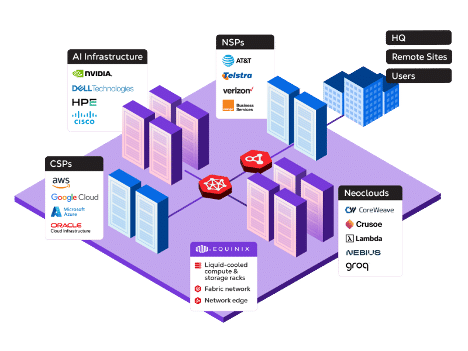
We recently announced two new solutions—both in preview with general availability planned for Q1 2027—that enable quicker and easier access to this ecosystem:
- Equinix® Inference Exchange is designed specifically to enable partner tiering, running distributed AI inference across a growing set of providers rather than one.
- Equinix® Fabric One™ extends this same choice and flexibility to connectivity. Institutions can state their intended outcomes, and the solution will automatically translate that intent into the required connections.
Together, these solutions ensure that Equinix customers can switch providers whenever it makes sense to do so. They won’t have to avoid switching just because it would require a complex and expensive infrastructure project.
Act now to ensure operational resilience for AI
As financial institutions plan to meet their capacity requirements for AI, they must consider this question:
“Is our preferred compute provider really meeting our needs, or are we just defaulting to them out of convenience?”
And, as a follow-up question:
“If we need to shift to different providers, can we move our workloads easily to make that happen?”
The time to answer these questions is now, before capacity requirements scale up yet again.
To learn more about how to intelligently scale AI capacity, read the white paper: “When Continuity Isn’t Enough: Why Financial Services Must Rethink Operational Resilience.”
[1] “AI to drive 165% increase in data center power demand by 2030,” Goldman Sachs, Feb. 4, 2025.
[2] Ivan Chiam, et al., “The Great AI Silicon Shortage,” Semianalysis Newsletter, March 12, 2026.
[3] Leo Gergs, “The State of Neocloud: Four Trends for 2026,” ABI Research, December 3, 2025.
[4] “Financial Stability in Focus: Artificial intelligence in the financial system,” Bank of England, April 9, 2025.


 Subscribe to the Equinix Blog