


TL:DR
- Public sector agencies face key misconceptions about digital sovereignty—true sovereignty centers on control over data, networks & AI workloads, not isolation or compliance alone.
- Hybrid multicloud architectures, private interconnection & software-defined networking enable agencies to enforce geographic data-routing boundaries while maintaining global connectivity.
- A vendor-neutral, globally distributed digital infrastructure foundation helps public sector agencies meet sovereignty requirements without sacrificing performance or mission agility.
Many public sector leaders recognize the need for digital sovereignty. In fact, national, regional and local agencies have begun to develop applicable guardrails that will assure privacy and data custodianship. These guardrails are part and parcel of leveraging and extracting value from varied sources of data. However, to get the right sovereignty strategy, they may first need to dispel several popular misconceptions.
For instance, digital sovereignty isn’t just about compliance. Agencies are expected to ensure public trust and protect the interests of the national, regional and municipal entities in which they operate, and it’s true that there are regulatory requirements employed to enforce those priorities. However, modern IT dictates that agencies should engineer sovereignty into the design and construct of their systems from the outset, not afterwards to meet compliance requirements. This is particularly important when custodianship of varied sources of data is an integral part of the end state.
Also, true sovereignty is about control, not isolation. The compliant, strategic placement of workloads is a key attribute of any effective data sovereignty strategy, and agencies can’t do that if they lack global reach and connectivity. They need the control to deploy infrastructure in the right places, move data freely, and connect with a global roster of partners to access key services. Despite what some might think, sovereignty doesn’t have to mean sacrificing agility or global connectivity. It simply means being thoughtful, intentional and compliant with data custodianship.
Finally, digital sovereignty is comprised of layers of compliance, and it’s certainly not an off-the-shelf solution you can buy from a single vendor. Each organization has its own unique sovereignty requirements, and the requirements of public sector agencies will often include nuances not found in their private sector counterparts. However, the core components of digital sovereignty are universal:
- Data residency: The physical location of the data.
- Data sovereignty: The legal governance covering the custodianship of data, including GDPR, the CLOUD Act, and myriad other national, state and local regulations that assure sovereignty for a given entity.
- Network sovereignty: Geopolitical boundaries established for the movement and/or sharing of sensitive data within jurisdictions.
- AI sovereignty: Working with different ecosystem partners to ensure choice and flexibility across AI infrastructure, models, inputs and outputs, and deploying private infrastructure when needed to ensure control over sensitive AI workloads.
With the application of these core components, agencies can maintain compliance with prescribed governance while also achieving the performance and flexibility needed to support their mission goals. This begins with deploying on a provider-neutral, interoperable, globally distributed infrastructure foundation.
Data residency doesn’t have to mean isolation
When it comes to the cloud, public sector agencies face a quandary: Cloud native environments have proven to be very effective, with near-infinite scale, on-demand consumption and built-in compliance frameworks. But they also present a challenge with their need for data residency in particular jurisdictions. An agency’s desired cloud regions are often misaligned with its prescribed data residency jurisdictions.
As our collective “cloud IQ” and use of digital infrastructure more broadly continues to evolve, organizations have begun to leverage digital services in a more balanced manner. Hybrid multicloud architectures have become far more common. As host to the world’s largest digital marketplace and a global interconnection provider, Equinix can help agencies deploy their hybrid multicloud architecture that best aligns with data sovereignty requirements.
For public sector agencies facing strict data residency requirements, colocation can provide the best of both worlds on a compliant foundation: They can deploy infrastructure on demand in all the right places, while maintaining required data sovereignty.
At the digital edge, they can also dynamically interconnect their colocation environment with varied cloud native and cloud-adjacent offerings. Frictionless, intelligent, software-defined orchestration enables intuitive and intentional provisioning of services. In turn, this enables rapid deployment of workloads and datasets wherever they’re required.
Consider the following notional use case: A multinational organization like NATO has various individual national regulations as well as organizational regulations to consider. A global interconnection provider like Equinix can meet many of these requirements. NATO member states like Sweden, Germany and Spain can find an Equinix location within their national jurisdiction to establish data residency while also leveraging myriad strategically located digital edge services to satisfy their modeling and inference requirements.
In most cases, they can satisfy their network sovereignty requirements using Equinix Fabric Geo Zones, a technical routing control within Equinix Fabric®, our software-defined networking (SDN) solution. Fabric Geo Zones is designed to support customer sovereignty and data-routing objectives. It ensures that data either flows via a permitted route within the configured geographic boundary or does not move at all. This helps organizations align network routing behavior with their sovereignty requirements using infrastructure-level controls rather than relying solely on application-level policies.
Equinix has data centers in 77 strategic markets across 36 countries, giving our customers the choice they need to localize their sensitive data. To enable each country to host critical data with confidence, we’ve established NIST 800-53/FISMA High compliance across all U.S. data center assets and ISO 27001 compliance across all overseas locations. We employ advanced biometrics and no fewer than five layers of physical security across our global data center portfolio.
Private connectivity is essential to move data in a compliant manner
Just like the public cloud is often the easiest way to access digital infrastructure, many organizations view the public internet as the easiest way to connect infrastructure environments. However, just like with the public cloud, relying solely on the public internet is incompatible with an effective sovereignty strategy.
The internet is a best-effort transmission medium. This means that agencies won’t be able to control exactly which route their data traffic takes to get from point to point. Even if traffic is moving between two trusted, compliant locations, it may pass through an internet exchange point in a third location along the way, crossing jurisdictional boundaries in the process.
Also, the public internet doesn’t offer observability for data in motion. This means that agencies could violate their data residency requirements without even knowing it. Additionally, the public internet can’t provide predictably low latency, so agencies should seek private, Ethernet-based transport for sensitive workloads.
Private connectivity solutions provide the control that agencies need to move their data freely across hybrid infrastructure environments without putting it at risk. Our public sector customers can use Fabric Geo Zones to enforce geographic boundaries for their data in motion. Fabric Geo Zones is currently available in eight different jurisdictions: Australia, Brazil, Canada, the EU, Japan, Switzerland, the U.K. and the U.S.
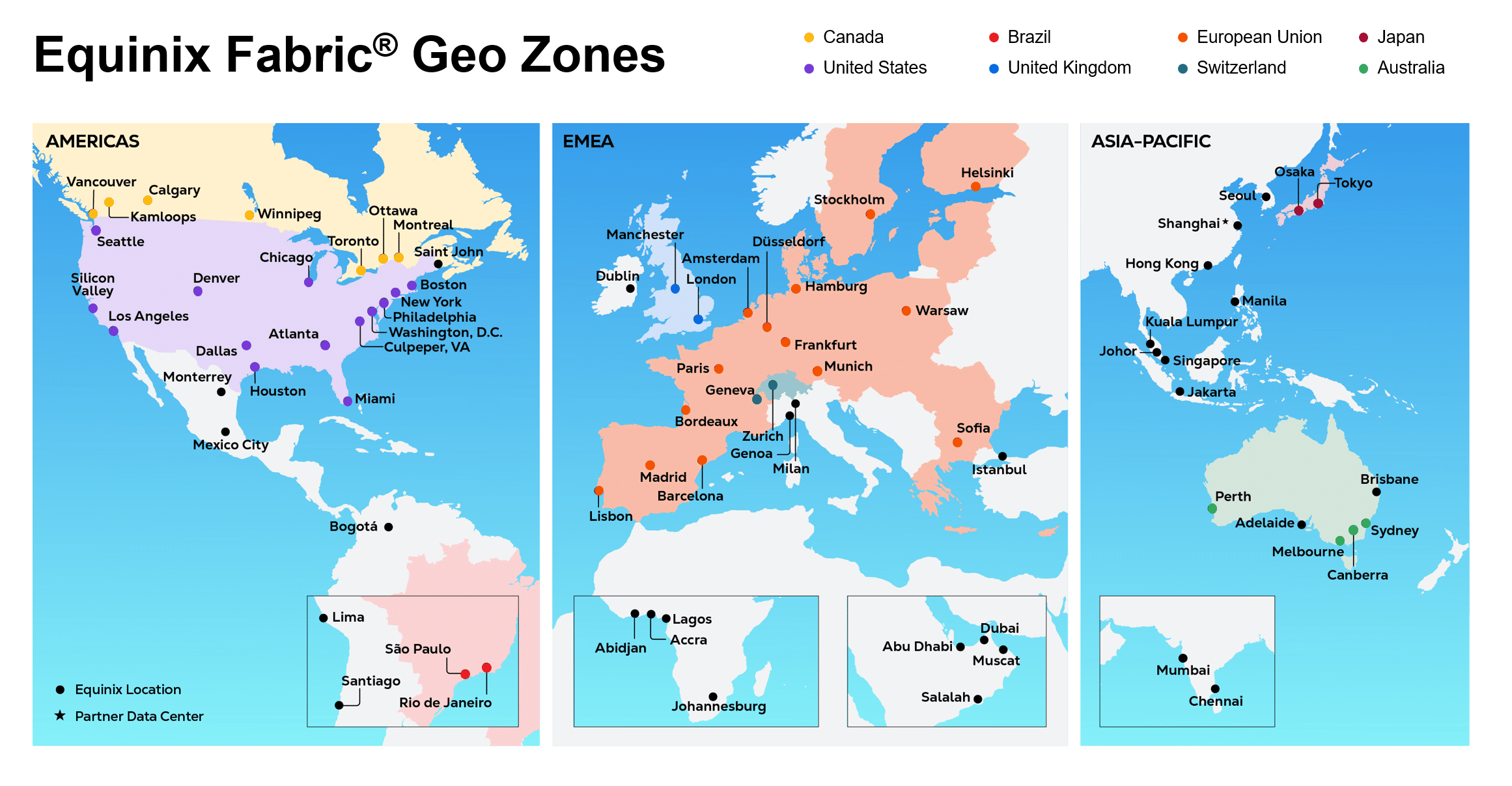
Traffic routing complies with relevant regulations in each jurisdiction, such as the EU Data Act and the LGPD in Brazil.
Enabling AI for public sector—without the risk
Many agencies are struggling to find the hardware and data center capacity they need to enable AI for public sector use cases. Turning to a vast ecosystem of partners at places like Equinix can enable them to break through supply-chain bottlenecks while also avoiding provider lock-in, spurring innovation, and improving cost-efficiency.
Model choice is also extremely important for AI sovereignty. If public sector agencies route all their AI workloads to frontier models by default, then they’re implicitly trusting those model providers to store and manage model weights on their behalf. That can introduce compliance risk. For AI workloads with strict data residency requirements, they’ll likely want to choose open-weight models instead. They can store the weights themselves on private infrastructure that they control, so there’s no risk of their AI datasets unintentionally crossing borders.
Deploying on a global colocation foundation can help agencies access many different models and AI ecosystem partners to enable their choice of compliant providers. Because Equinix data centers are vendor-neutral by design, our customers can deploy private infrastructure for their AI workloads that require it, while also accessing a wide variety of different clouds, neoclouds and model providers when it’s appropriate to do so.
Make sovereignty a reality for your agency
With Equinix’s global portfolio of AI-ready colocation data centers, private interconnection solutions, and dense AI ecosystem, we offer what public sector agencies need to take on their biggest sovereignty challenges.
Equinix continues to make significant investments in our regulatory-compliant data centers and SDN-enabled interconnection framework, thus supporting the sustained readiness and resiliency of our global infrastructure foundation. Learn more about how you can partner with Equinix to deliver on your most mission-critical high-performance compute initiatives, including AI. Read our brief, “Build sovereign infrastructure for modern government.”

 Subscribe to the Equinix Blog