


TL:DR
- AI agents for autonomous networking require real-time network observability to determine when changes are needed and confirm those changes achieved the intended result.
- Effective observability platforms deliver streaming telemetry, contextual data across network domains, historical records and machine-readable interfaces agents can query directly.
- Closed-loop network automation, where agents act and self-verify, enables enterprises to manage digital infrastructure with greater precision and reduced reliance on human oversight.
Imagine this scene: It’s 2:00 A.M. and your network experiences an unexpected spike in traffic. Your primary cloud connection is close to being overloaded, putting key services at risk. What happens next?
With autonomous networking capabilities, AI agents can automatically shift traffic to a secondary connection, thus avoiding potential delays and packet loss on the primary. This all happens instantly and automatically, so you and your team can remain sound asleep.
In the future, scenes like this one will become commonplace. The value of network automation is already widely recognized: According to one research report from Omdia, 93% of organizations agree that network automation will be essential for keeping pace with future change, while 88% agree that AI itself will be required for effective network automation.[1] But the point that’s so often missed in this discussion is that network automation is impossible without observability.
In our example, the only reason the agent was able to make the right change at the right time is that the observability layer triggered it once bandwidth on the primary connection crossed a certain threshold. The agent would then be able to go back to the observability platform to gauge the impact of that change.
On both accounts—the agent making the change and confirming that it helped solve the issue—network automation is dependent on making telemetry available to agents in real time. Without the observability layer, network agents would have all the power but none of the intelligence.
Observability enables the next stage of network modernization
In a previous blog post, an Equinix colleague discussed how software-defined networks are giving way to intelligent networks. Software-defined networks are programmable, but they still rely on people to monitor dashboards and make important changes based on what they see. With intelligent networks, there’s no need for humans to monitor network performance. This means that organizations must replace human-readable dashboards with machine-readable telemetry.
Going back to our earlier example, the agent received real-time streaming telemetry that helped identify the crossed bandwidth threshold. If the network had relied on humans monitoring dashboards, no one would have even known about the issue until the following morning.
In addition to keeping agents informed about the current state of network operations, the observability layer needs to provide context so that agents can interpret and act upon that data. It’s not enough to know that a spike in traffic occurred; the agent needs background about why it occurred, what the possible outcomes might be, and what the appropriate response is. For instance, if a spike occurred during a scheduled maintenance window, this should be treated differently than a spike during regular operating hours. In this case, the spike may be directly caused by the planned maintenance work, so the agent should avoid interfering.
The context should cut across different network domains to help agents get to the root cause of an issue. It should consider the security implications of a particular incident, and also look closely at which applications and cloud services are dependent upon the connection in question.
All this context can provide the clearest, most complete picture of what’s happening in the network, and help determine what the appropriate response would be. It could even help address concentration risk: Agents can ensure that network redundancy is enforced at the physical infrastructure layer instead of just shifting between providers that all depend on the same underlying connections.
The observability platform should also provide access to historical data, which allows the agent to base its response on what happened during previous incidents.
Agents must verify their own network changes
True network automation should be a closed loop. This means that the agent should not only perform the required change, but also go back to the observability platform to confirm that it had the intended result. This highlights the difference between scripted network automation and true autonomous networking. A script can only perform the action it was designed to perform; it’s unable to check whether that action made a difference. Therefore, it only covers the first part of the loop.
In our example, the observability tool would be able to check whether traffic on the primary connection returned to normal levels, and whether the network was able to avoid higher latency and dropped traffic. If the change was successful, the agent would record that fact for future reference. If not, it could attempt a different remediation tactic or escalate the situation to a human network engineer for further investigation.
Network teams can also look at the records that an agent logs to determine whether the agent is operating the way it’s supposed to. They can use this evidence to help decide if they should maintain or extend the agent’s permissions in the future. This kind of control is essential to enable an informed strategy for governance in agentic AI.
What’s required for machine-readable observability? A checklist
When enterprise networking leaders build the observability platform that supports their network automation strategy, they must ensure that telemetry meets the following criteria:
- It must be streamed in real time. As new events are detected and new metrics are captured, they must be passed on to agents automatically.
- There should be no extra steps required to access the telemetry. It must be accessible to agents on the same interface that they already use to perform network management.
- Agents should be able to query the telemetry via an open, standardized interface such as the Model Context Protocol (MCP).
Pairing agents with the network intelligence they need
In order to help AI agents complete the full loop of network automation, we released Equinix Fabric® Intelligence™ earlier this year. This solution covers both sides of the equation:
- Fabric Insights is integrated with third-party observability tools like Splunk and Datadog, and it analyzes real-time telemetry to help predict anomalies and manage overall network health.
- Fabric Super Agent is an AI agent for Equinix Fabric. It allows users to look up their inventory, search the Equinix Fabric catalog, get help designing connections, and walk through guided workflows to create new resources. Users can interact with Fabric Super Agent via natural-language prompts in chat tools such as Microsoft Teams and Slack. It can also help set observability streams, alerts and rules.
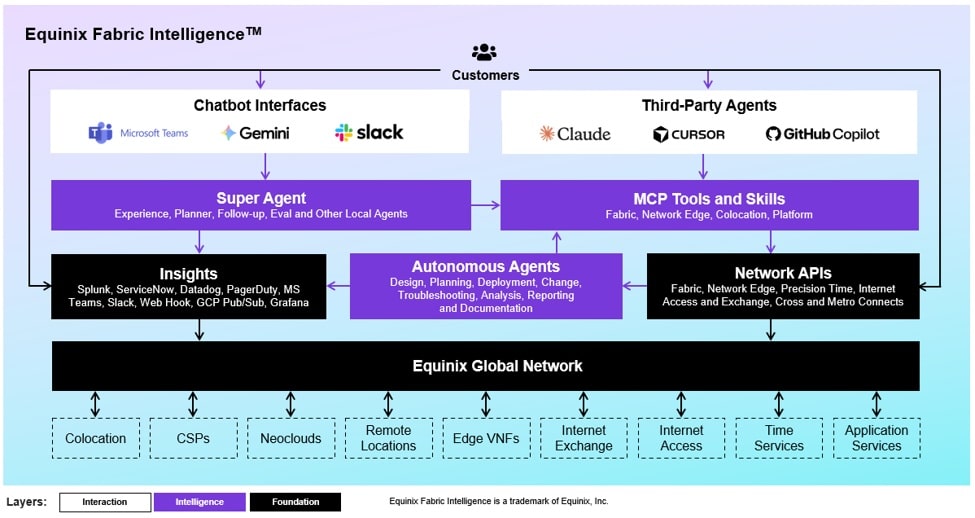
Our customers can enable true autonomous networking by pairing external agents with the observability and MCP capabilities found in Equinix Fabric Intelligence.
In the months since we first announced Equinix Fabric Intelligence, we’ve continued to expand its capabilities with new product updates. For instance, we announced the availability of network maintenance notifications in Fabric Insights, which can provide the context agents need to differentiate between planned maintenance and a true anomaly.
Also, we recently announced Equinix® Fabric One™, our managed, intent-based networking service designed to enable any-to-any connectivity at global scale. Our customers will be able to declare their intended business outcomes, and Fabric One will create the needed connections automatically. This kind of intent-based networking will further raise the stakes for observability, because it will create new demand for agents to manage networks without human oversight or verification.
Learn more about how network intelligence is enabling the future of business: Read the white paper, “Why intelligent networks are essential in the AI era.”
[1] Omdia Research Report, The Return of NetDevOps: Inside the Convergence of AI, Networking, and Automation, January 2026.

 Subscribe to the Equinix Blog