

TL:DR
- Liquid cooling is becoming essential as rising compute demand, higher rack densities and distributed computing increase data center heat loads.
- Understanding liquid cooling myths, augmented air cooling, immersion cooling and direct-to-chip cooling enables informed planning.
- Mastering liquid cooling architecture and partner collaboration supports efficient AI-ready infrastructure deployment at scale.
We know that many of our customers are interested in liquid cooling, both in terms of how it enables high-density workloads like AI and how it could help improve the overall efficiency of their operations. That’s one reason we recently announced Equinix Enhanced Performance Innovation Centers (EPIC), a network of production-ready liquid cooling environments where our customers can test, build and deploy with confidence.
Over the years, we’ve covered liquid cooling many times on this blog, from many different angles. Today, we’ve decided to go back into the archives and gather all our expertise on the topic in one place.
Read on to learn more about liquid cooling: why so many companies are adopting it these days, the common misconceptions surrounding it, the different varieties that exist within data centers, and the different components you might find inside a liquid-cooled system.
Liquid cooling isn’t just about enabling AI
While it’s true that high-density AI hardware plays a significant role in driving demand for liquid cooling in data centers, it’s not the only factor. Over the past several years, three main trends helped make liquid cooling essential:
- Higher compute demand: Compute power has been increasing consistently for decades, and AI is just the latest chapter in that story. Even today, AI isn’t the whole story. Things like virtualization, containerization, and more demanding security processes all drive higher compute demand, which in turn drives the need for liquid cooling.
- Density and space constraints: Today’s data centers consolidate more compute power into fewer server racks. However, the total number of racks is still increasing, and space inside data centers is limited. On top of this, operators need to run servers very close together to ensure ultra-low latency. Taken together, all these factors lead to one simple outcome: much more heat generated in the same footprint. Liquid cooling helps, both by transferring heat more efficiently and by taking up less space between racks.
- Distributed computing: High-density compute workloads are increasingly distributed across many locations throughout the world. Again, AI is a big part of this, but compute at the edge is essential for any latency-sensitive workload. This means that enterprises need access to liquid cooling in more places, not just in their core data centers.
Read the blog post to learn more: “3 Trends Driving Liquid Cooling for Data Centers.”
Liquid cooling is frequently misunderstood
With so many people out there learning about liquid cooling for the first time, it’s easy for misconceptions to take hold. Let’s clear up some of those myths:
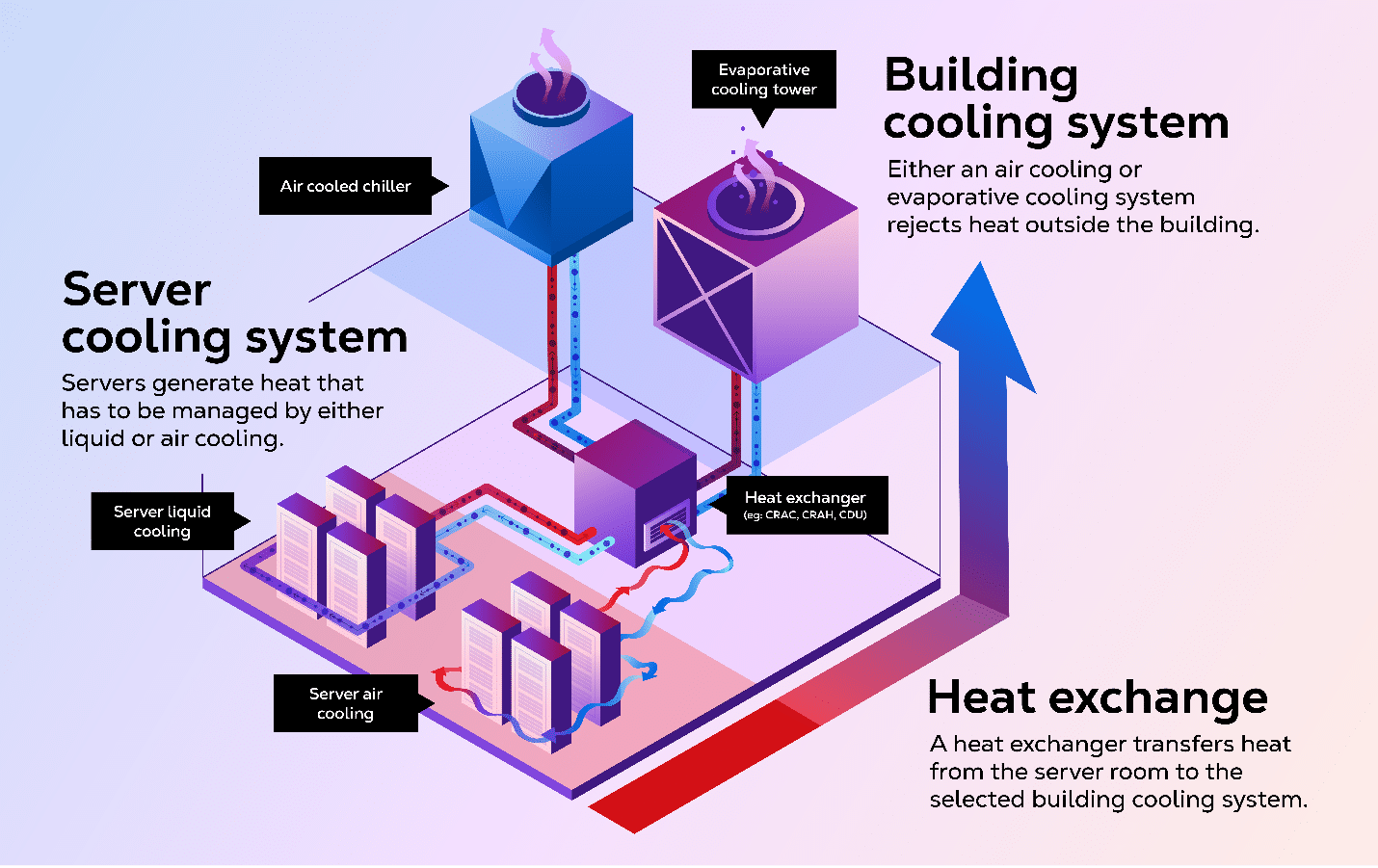
- Myth: Liquid cooling and evaporative cooling are the same thing.
- Fact: Liquid cooling takes place at the server level, while evaporative cooling happens at the building level. Unlike evaporative cooling, liquid cooling typically doesn’t drive significant data center water consumption.
- Myth: Liquid cooling will completely replace air cooling.
- Fact: Liquid cooling isn’t right for every workload, and it will be used alongside air cooling for the foreseeable future. This includes instances where liquid-cooled and air-cooled components coexist within the same system.
- Myth: Existing data centers can’t be retrofitted to support liquid cooling.
- Fact: Adding liquid cooling capabilities to legacy facilities is possible, but it’s not easy. It requires significant updates and rigorous policies, so it’s important to work with partners who have the required expertise.
Read the blog post to learn more: “Top 3 Liquid Cooling Myths Debunked.”
There are different kinds of liquid cooling
Organizations will choose different kinds of liquid cooling for different reasons:
- Augmented air cooling: When existing chilled water coils are moved closer to the heat source to make air cooling more effective. It requires no server-level changes, so it’s quick and easy to implement.
- Immersion cooling: When servers are immersed in a large vat of technical cooling fluid. It requires extensive changes at the server level and the data center level. This leads to significant costs and complexity, so it’s no surprise that we’re seeing low adoption of immersion cooling.
- Direct-to-chip liquid cooling: When a cold plate sits on top of the chip within the server, with both supply and return branches moving coolant through the cold plate. It requires minimal changes to the server exterior and can be installed inside a standard cabinet footprint. This is one reason it’s the most commonly adopted variety of liquid cooling.
Read the blog post to learn more: “Exploring Liquid Cooling for Next-Gen Business Applications.”
Liquid cooling is multifaceted and collaborative
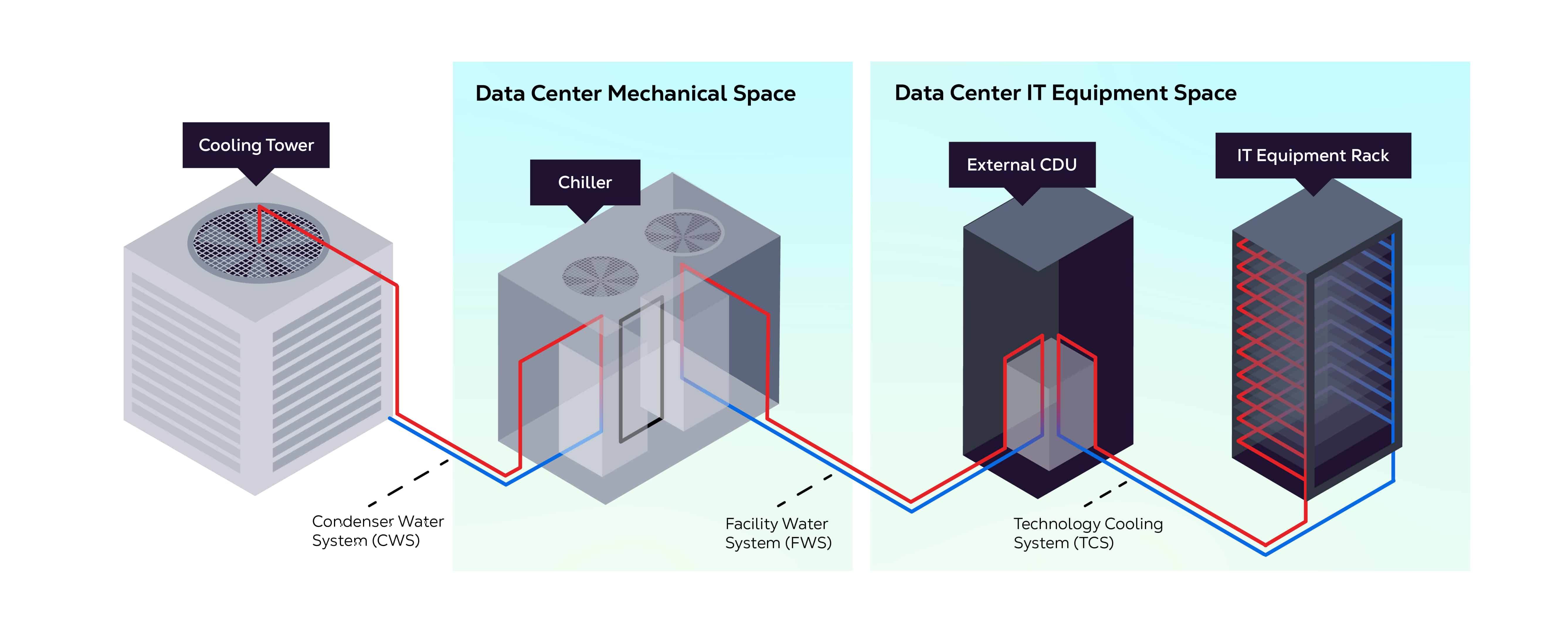
Direct-to-chip liquid cooling is not one specific piece of technology. It’s a system made up of four interconnected layers:
- Facility-level coolant distribution: The piping that moves coolant throughout the data center.
- Coolant distribution unit (CDU): The exchange point between facility cooling and server cooling.
- Rack-level cooling and control: The equipment that moves fluid to and from individual racks, while providing visibility and control over temperature and pressure.
- Leak detection and containment: Just like it sounds. The devices that help limit the risk of coolant leaks.
It’s important to understand that these four layers aren’t owned and managed by a single entity. Liquid cooling in a colocation data center is the shared responsibility of the colocation provider, the customer, and the OEM.
Learn what it takes to enable coordination and collaboration across the liquid cooling ecosystem: Read the blog post “The Anatomy of a Direct-to-Chip Liquid Cooling System.”
Get started with liquid cooling today
Success with liquid cooling starts with choosing the right partner. You need a provider that’s not only experienced with the technical details of liquid cooling, but also experienced playing the role of a trusted, collaborative advisor. That partner should also offer vendor-neutral infrastructure and global reach, so that you can build the liquid-cooled environment that’s right for you, right where you need it.
Learn why Equinix is well-suited to be your trusted partner for liquid cooling, and how our Enhanced Performance Innovation Centers can help you deploy with confidence. Read the solution brief: “Liquid cooling, live in production.”

 Subscribe to the Equinix Blog