


TL:DR
- Financial institutions face urgent post-quantum cryptography risk, as “harvest now, decrypt later” attacks mean sensitive financial data may already be compromised today.
- Infrastructure adaptability and crypto-agility allow firms to swap cryptographic algorithms without full redesigns, enabling phased post-quantum cryptography migration alongside compliance with resilience regulations.
- Equinix’s global colocation footprint and partner ecosystem give financial institutions the digital infrastructure needed to test, pilot and deploy quantum-safe frameworks at scale.
Quantum computers will break traditional encryption algorithms, and it will most likely happen a few short years from now. Cyber-criminals are already working to take advantage of this: They’re gathering encrypted datasets today and waiting to decrypt them once powerful quantum computers become widely available.
Harvest now, decrypt later (HNDL) attacks could be particularly damaging in the financial services industry, where protecting sensitive data is essential and the penalties for failing to do so are high. Preparing for post-quantum cryptography (PQC) is among the top cybersecurity priorities facing financial institutions today.
To paraphrase Giuseppe D’Acquisto from the Italian Data Protection Authority, it’s a problem of asymmetry: Attackers are already living in the future, while defenders are stuck in the present.[1] Infrastructure adaptability can help break through this asymmetry. Financial institutions can take the right steps today to meet their future PQC needs.
Financial datasets are already at risk
As my Equinix colleague discussed in a previous blog post, 2029 is widely considered the deadline for implementing post-quantum cryptography. However, this doesn’t mean that there’s time to spare. Mosca’s Theorem shows why. According to the theorem, data is already exposed when its shelf life and migration timeline combined is longer than the timeline for quantum cryptography threats to start emerging.
Many financial institutions are on the wrong side of this equation. For instance, insurers often need to keep policyholder data confidential for 30 years or more. Banks and capital markets may have shorter retention timelines, but this is typically offset by higher complexity, which leads to longer migrations.
Instead of targeting 2029, financial institutions should accept that their data may already be at risk. To address this, they should focus on the only part of Mosca’s Theorem they control: the speed of their PQC migration.
Many organizations recognize the importance of quantum readiness, but there’s a gap between intent and results. According to one Capgemini survey, 70% of organizations are working on quantum-safe solutions or planning to do so in the next five years. However, only 15% of these early adopters are “quantum-safe champions” who lead in both organizational and technical foundations.[2]
Regulations demand PQC tomorrow and crypto-agility today
As the timeline below shows, regulators in different jurisdictions have established different target dates for quantum readiness.
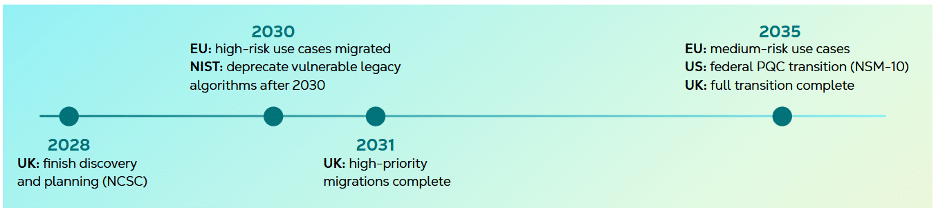
It’s noteworthy that they all converge on 2035 as the final deadline for most use cases, while leading tech companies are instead converging on 2029. This shows that there’s a gap between what’s legally required and what’s advisable. Financial institutions should be proactive about addressing quantum risk, instead of doing the bare minimum they’re legally compelled to do.
In addition to regulations calling for future PQC migration, there are regulations calling for crypto-agility today.
What is crypto-agility?
Crypto-agility is the ability to swap algorithms and key types without a redesign.[3]
The European Union’s Digital Operational Resilience Act (DORA) does not explicitly mention quantum, but it does define managing cryptographic vulnerabilities as an operational resilience factor that financial institutions must account for.[4] Therefore, the need for crypto-agility is implied.
Financial institutions must be ready to meet this requirement in the short term. It can help set the stage for long-term PQC migration, but the two are not interchangeable. They are separate but complementary strategies, and completing a successful PQC migration does not remove the need for ongoing crypto-agility.
What does it take to ensure quantum-ready digital infrastructure?
PQC migration is not a matter of simply dropping in one algorithm to replace another. Post-quantum algorithms have larger key sizes and heavier computational overhead, and current financial protocols weren’t designed to account for these factors. This is why PQC migrations can be so complex and time-consuming for financial institutions.
As they pursue PQC, firms will inevitably ask their infrastructure to do things it wasn’t intended to do. This makes global infrastructure adaptability essential for quantum readiness. They must start working to enable this adaptability today, several years before they’ll really need it.
There are four steps that financial institutions must take to ensure quantum readiness:
- Test their production workloads for operational resilience, as required by DORA.
- Begin a PQC pilot program to test the operational impact before the true migration begins.
- Validate larger key sizes to understand how they might lead to higher latency and integration complexity.
- Start building crypto-agility today, with the understanding that harvested data may already be at risk.
The race to quantum-safe finance is underway
While it’s true that the industry as a whole isn’t adequately prepared for PQC migration, certain organizations have taken a leading role, and are already testing quantum readiness under live conditions:
- BIS Project Leap, a collaboration led by the Bank for International Settlements (BIS) Innovation Hub, first established a quantum-safe communication channel for interbank payment messages. Then, Phase 2 of the project tested post-quantum digital signatures in the Eurosystem’s T2 real-time gross settlement system.[5]
- JPMorgan Chase has explored both PQC at the application layer and quantum key distribution (QKD) at the network layer.[6]
- HSBC, in partnership with BT and Toshiba, has used QKD to protect live foreign-exchange transactions in the U.K.[7]
These examples all show that while it’s difficult to adapt infrastructure for quantum readiness without disrupting current operations, it’s not impossible.
Who can firms partner with to enable quantum readiness?
PQC may seem like something completely new and different from what financial institutions have dealt with in the past, but they can overcome this challenge using the established principles of infrastructure adaptability. Equinix is the place where financial institutions can put those principles into action.
We offer a global portfolio of colocation data centers and interconnection solutions that customers can use to deploy upgraded hardware security modules, test new cryptographic standards, and build crypto-agile frameworks. They can do all of this quickly, without redesigning the physical infrastructure between each change.
Also, our dense partner ecosystem includes many leading security providers. Our customers can connect to these providers quickly and easily to advance their PQC migrations. This includes network providers that offer quantum-safe connectivity from within our data centers. Earlier this year, Telecom Italia Sparkle announced that their Quantum Safe Interconnect offering is available in 20 Equinix locations globally, with future plans to expand into even more data centers.
At Equinix, financial institutions can find everything they need to turn PQC migration into a concrete strategy they can start pursuing today, instead of just an abstract future deadline to consider.
To see the complete quantum-readiness framework, and to learn more about other shifts impacting the financial industry, read the white paper: “When Continuity Isn’t Enough: Why Financial Services Must Rethink Operational Resilience.”
[1] Giuseppe D’Acquisto, Security preparedness under the GDPR: the (possible) PQC impact, ENISA, December 8, 2025.
[2] Future encrypted: Why post-quantum cryptography tops the new cybersecurity agenda, Capgemini Research Institute, 2025.
[3] Giuseppe D’Acquisto, Security preparedness under the GDPR: the (possible) PQC impact, ENISA, December 8, 2025.
[4] Regulation (EU) 2022/2554 of the European Parliament and of the Council of 14 December 2022 on digital operational resilience for the financial sector, Article 9: Protection and prevention, Official Journal of the European Union.
[5] Project Leap: Quantum-Proofing Payment Systems, BIS Innovation Hub, December 2025.
[6] AI and Quantum: Catalyst for Transformative Growth in Financial Services, Oliver Wyman, 2025.
[7] Toshiba and HSBC pioneer quantum protection for AI-powered FX trading, Toshiba Press Release, May 2023.

 Subscribe to the Equinix Blog