


TL:DR
- Digital sovereignty is an architecture decision, shaped by 3 critical factors: the facility, the data-in-transit path and the reachability of the broader ecosystem.
- Organizations must define which laws apply to their data, control plane and operating entity before selecting infrastructure — jurisdiction precedes geography in sovereign planning.
- Addressing sovereign connectivity gaps across multicloud and hybrid digital infrastructure helps organizations avoid compliance failures, costly lock-in and loss of ecosystem reach.
There is one question I put to every infrastructure provider, and I have yet to hear a complete answer: When my data leaves your building, who can touch it?
The answer is almost always encryption. Encryption matters, but it is not the same as control. Someone still operates the path, and that path can cross a jurisdiction nobody agreed to. Someone can interfere with that path or cut it off. A datacenter point of presence is not fit-and-forget.
Sovereignty is now an architecture decision
Seventy-three percent of organizations surveyed by IDC say the geopolitical and regulatory upheaval in the first half of the year has increased their interest in sovereignty (IDC’s Worldwide Digital Sovereignty Survey, 2026). These organizations are not buying a product: 46% deploy sovereign infrastructure as one component of a multicloud or hybrid estate, while 44% make it their main platform. Portfolios are designed, not purchased, which means this is an architecture question long before it becomes a procurement one.
Why cutting the cable is the wrong answer
Of course, there is an easy answer to my question above: Disconnect and/or air-gap the environment so that the issue never arises. But according to IDC research, this is not where buyers are going. Part of that is due to supply (in IDC’s 2025 survey, 21% of respondents named the absence of providers offering sovereign connectivity as an obstacle to diversifying their technology estate), making the sovereign path the trickiest part of this market.
Mostly, though, it is a choice. At 26%, air-gapped is the least used of the seven sovereign platform types we asked about. When asked how their increased interest in digital sovereignty will affect their cloud and IT usage in the next 12 months, only 4% of respondents said they intend to stop using global public cloud providers altogether, while 34% plan to use a combination of local and global vendors. Air-gapping is simply the extreme form of the same instinct, and organizations minded to cut the cable would also be cutting ties with their global providers and ecosystem that many workloads still depend on.
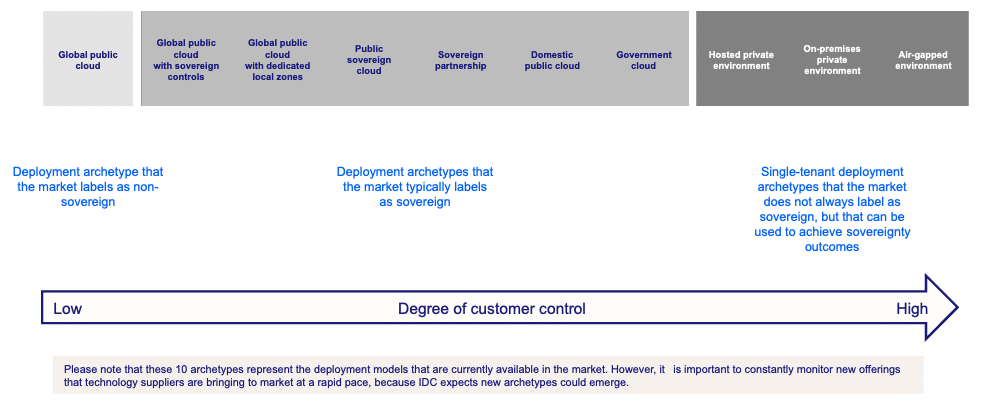
Figure 1
IDC’s ten sovereign deployment archetypes, with the underlying facility and interconnection layer
Source: IDC’s Sovereign Deployment Model Archetypes: A Guide for IT Decision-Makers, March 2026
The three places where sovereignty is decided
So if disconnection is not the answer, where is sovereignty settled? Largely in a decision organizations believe they have already made. As shown in Figure 1, IDC’s framework sets out ten sovereign deployment archetypes, from global public cloud to a fully air-gapped environment. That choice resolves which legal entity holds the contract, which controls apply to the data, and who runs the technical and operational layers. However, three aspects are left open — and they decide the outcome in practice.
First, the building: A third party operates the facility in eight of the ten archetypes, and a network is present in nine of them. Three of the ten are not sold as sovereign cloud at all, so a buyer searching for that term is choosing from seven options rather than ten. Those three keep the facility and the interconnection under the customer’s control, with colocation as the clearest example. It is overlooked because sovereignty is marketed as a cloud category, so that is where buyers look. Yet 12% of respondents already hold their most sensitive data in on-premises private cloud or in colocation, which is a sovereign posture whatever it is called.
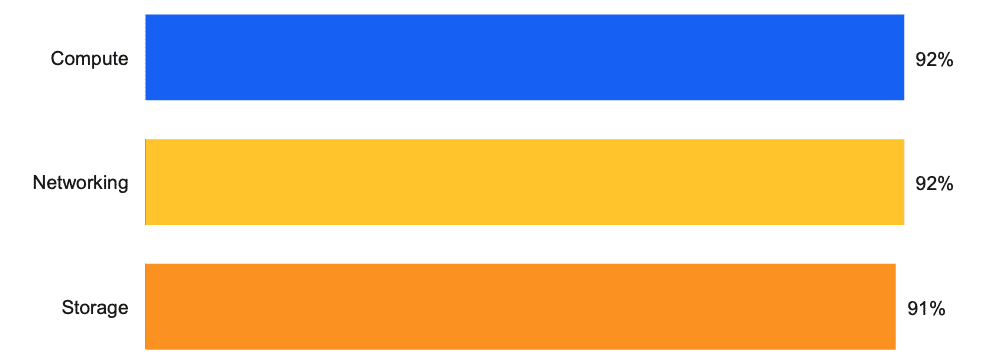
Second, the path: Sovereign control of networking is now rated “very” or “extremely” important by 92% of organizations, level with compute (see Figure 2). But importance is not specification. Only 31% name sovereign control of all network infrastructure and connectivity among the attributes they look for in a partner, and for most of the ten archetypes the deployment choice settles nothing about how data in transit is governed. It shows up at the worst moment: a failover where data was rerouted across jurisdictions nobody agreed to, which is why 42% of respondents now name regulatory compliance during failover among their main concerns.
Third, what stays reachable: A sovereign environment that nothing else can reach is of limited use, and buyers know it. In IDC’s survey, 28% named a strong ecosystem of partners adhering to sovereign principles as an important attribute in a provider. That is a requirement about reach, not control. AI is where it bites the hardest, with 63% treating dependency on foreign AI providers as a major or moderate concern. However, control that removes reach also removes options. For a few workloads that is the intention, but for most it is a cost that surfaces only once the architecture is fixed.
Foreign interference cuts both ways
Digital sovereignty is not a European preoccupation: rising interest is near-identical in Western Europe, Canada, Asia/Pacific and Japan, and the Middle East, Türkiye, and Africa (all at 73%, with North America at 70%). A provider that is sovereign at home may be considered foreign elsewhere, since it is subject to the laws reaching its legal entities and operations. The question is not whose flag is on the building but which laws apply to the data, the operating entity, and the control plane. Buyers have worked this out: When asked where current sovereignty offerings fall short, 40% of respondents pointed to the lack of guaranteed protection against extraterritorial data access.
What should organizations do?
Our advice is to settle three things before choosing a location.
First, decide which laws must apply to your data, your operating entity, and your control plane. Jurisdiction comes first, geography second.
Second, put data in transit into the requirement. Then ask every party in the chain which sovereign controls it applies to data crossing the section of the path it operates, and whether it can demonstrate them. Each of these answers for a different section, and what is not in the requirement will not be in the architecture.
Third, price the exit while there is still leverage. In 2025, 39% of respondents named high switching costs and contractual lock-in as their biggest obstacle to diversifying, and that cost is fixed on the day the contract is signed.
If enforcing residency along a fixed path is this difficult, consider what happens when workloads start choosing their own. Agentic systems will negotiate their own connections at machine speed, across whatever is reachable. I have yet to hear a convincing account of how sovereignty is enforced in that world, and I would be glad to hear from anyone who believes they have one.
For the full picture of where sovereignty is decided across the ten deployment archetypes, read the IDC InfoBrief: IDC Token optimization begins with choice
Figure 2
Sovereign control of the network now rates level with control of compute
Q: Rate the importance of applying sovereign controls to the following IT infrastructure. [Percentage of respondents rating controls “very” or “extremely” important]
Source: IDC’s Worldwide Digital Sovereignty Survey, June 2026 (n = 633)
Message from the sponsor
How well does your current architecture support your sovereignty requirements? Assess your posture with the Equinix Sovereignty Navigator: https://www.equinix.com/sovereignty-navigator

 Subscribe to the Equinix Blog